

Finger Bridge to Launch in Mid-September, Establishing Shared Infrastructure for Financial Connectivity
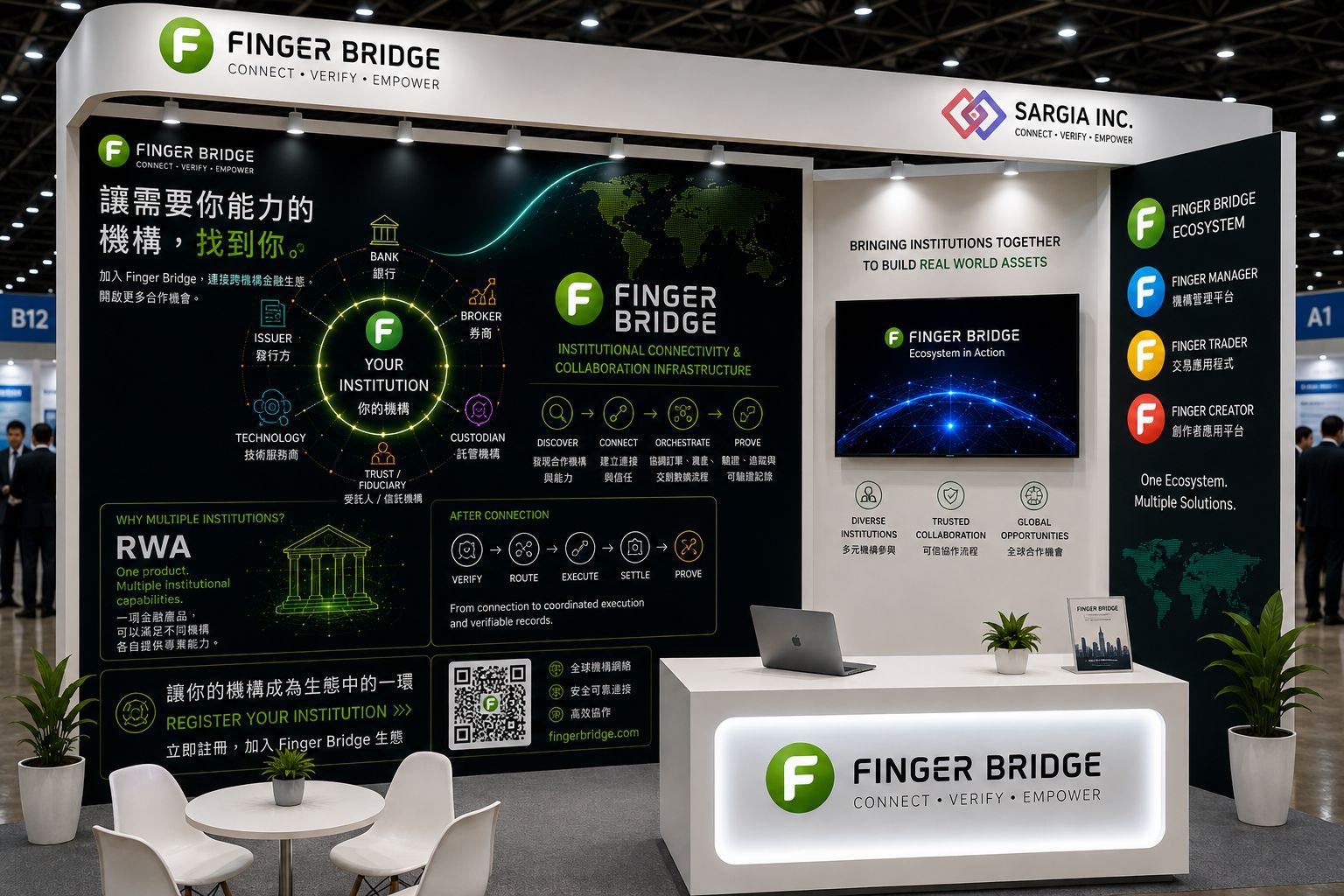
Finger Bridge
Designed to reduce repetitive integration and workflow coordination in new partnerships—while making capabilities easier to discover, connect and combine.
OSAKA, JAPAN, September 2, 2026 /EINPresswire.com/ -- OSAKA, Japan — September 2026 — Sargia Inc., a Japan-based financial technology company, announced that Finger Bridge, the cross-institution financial connectivity and collaboration infrastructure within the Finger Grid ecosystem, is scheduled to officially launch in mid-September 2026.Finger Bridge is designed for institutions that need to connect with other financial institutions, markets and business systems. It turns recurring elements of cross-institution collaboration—including institutional discovery, system connectivity, information verification, routing, workflow coordination and status tracking—into reusable shared infrastructure.
Finger Bridge starts with a simple question:
When financial institutions need to work with more institutions, why should every new relationship require another connection to be built from the ground up?
Today, connecting with a new bank, broker, issuer, custodian, trust institution or technology provider can mean reconfirming technical interfaces, data formats, identities and permissions, workflows, verification requirements, status updates and operating arrangements.
As the number of counterparties and business scenarios grows, so does the burden of repeated point-to-point integration and coordination.
Finger Bridge is not intended to change the role of the financial institution. It is intended to change the way institutions repeatedly establish connections with one another.
Making institutional capabilities easier to discover
The first challenge in cross-institution collaboration is often not technical integration. It is identifying an institution with the capabilities required for a particular business relationship.
Institutions joining Finger Bridge can represent their institutional role and business capabilities within the ecosystem. The value is therefore not limited to finding another institution when a need arises. An institution itself becomes a discoverable capability within the network.
An institution seeking custody capabilities can identify relevant custodians. Participants looking for brokerage, issuance, trust, banking, asset-management or technology capabilities can similarly identify institutions relevant to their requirements.
Institutions can discover the capabilities they need, while making their own capabilities discoverable to institutions that may need them.
Once a working relationship is established, Finger Bridge extends beyond Discovery into Connectivity, Routing, Orchestration and Traceability.
Beyond connecting another API
Finger Bridge is not simply an institutional directory or matching service.
Its broader role is to establish a shared connectivity layer across organizational and technical environments, coordinating how data, orders, assets and business processes move between participating institutions under defined operating rules.
Finger Bridge organizes its core capabilities around Unified Connectivity, Smart Routing, Business Orchestration and Full Traceability. Its information lifecycle follows:
Source → Verify → Route → Execute → Settle → Prove
Existing data sources, APIs, files and business systems can be connected through the shared layer, while information is verified, routed, delivered and coordinated according to the relevant permissions and workflow. Participants retain visibility into flow status and delivery context without having to reconstruct the process across disconnected tools.
The objective is straightforward: make recurring technical and operational collaboration more reusable, rather than requiring every new institutional relationship to introduce an entirely separate connection model.
Different institutions, different value
Finger Bridge does not assume that every institution faces the same problem.
For issuers, the value may lie in reducing repetitive integration when connecting with brokers, custodians, settlement, verification and other service providers. For brokers and banks, it can provide a common path to new products, institutional capabilities and business systems while reducing the complexity of maintaining multiple connection methods.
For custodians, trust institutions and other specialist providers, joining the network makes their capabilities more discoverable to institutions actively seeking those services. For asset managers, exchanges, wallets and technology providers, Finger Bridge provides a common entry point for connecting with other financial roles, markets and operating systems.
The Finger Bridge ecosystem currently organizes connection paths around institutional roles including Issuers, Brokers, Banks, Asset Managers, Trust Institutions, Exchanges, Wallets and Developers. Its institutional onboarding process then progresses from role and business-goal selection through jurisdiction, account creation, role-based KYB, network discovery and API/integration.
Shared connectivity does not mean giving up control
For financial institutions, collaboration is not only an efficiency question. It is also a question of data, permissions, confidentiality and responsibility.
Finger Bridge is not designed to make sensitive commercial information between participating institutions publicly visible. Instead, it coordinates the information flows and workflow states required for collaboration within defined permissions and institutional boundaries.
Relevant participants may need visibility into states such as submitted, pending verification, under review, approved, executing, pending settlement or completed, together with the necessary delivery context. Business documents, customer information, access permissions and internal decisions remain subject to the systems, policies, contractual arrangements and regulatory requirements of the institutions responsible for them.
Connectivity can be shared. Control and responsibility remain with the institution.
Finger Bridge does not replace the existing financial functions of banks, brokers, custodians, trust institutions, exchanges or other financial service providers. Technical connectivity does not transfer responsibility for business decisions, participant access, asset eligibility, customer-related decisions or regulatory obligations away from the relevant institution.
Why RWA illustrates the need for cross-institution collaboration
Real-World Assets (RWA) provide a practical example of why this type of infrastructure matters.
Tokenizing a financial product does not make the financial functions surrounding that product disappear. Issuance, distribution, brokerage, custody, trust or fiduciary functions, verification, settlement and technical connectivity may still be performed by different institutions.
Finger Bridge is not designed to make one institution perform every role. Instead, each institution continues to perform its own professional and regulated functions, while a shared connectivity layer reduces the friction involved in establishing connections and coordinating workflows across those roles.
What needs to change is not the role of each institution, but the way those roles connect and collaborate with one another.
RWA is therefore one practical use case for the Finger Bridge multi-institution collaboration model—not the only category of financial product the infrastructure is designed to support.
From workflow status to verifiable records
Once a process moves across multiple institutions, another question emerges: where did the information originate, what stage has the process reached, and can completed activity be verified?
Finger Bridge extends the information lifecycle through to Prove. Through Proof Explorer, transaction and workflow records can be examined using identifiers such as an Order ID or Transaction Hash, providing a traceable path across different processing stages. Finger Bridge describes this broader model as end-to-end traceability across connections, transfers and execution states.
This means Finger Bridge addresses more than connectivity:
Once institutions are connected, how does information move, how are workflows coordinated, how is status understood, and how can completed activity leave a verifiable record?
A shared layer—not another closed financial platform
Finger Bridge is scheduled to officially launch in mid-September 2026.
Its objective is not to require financial institutions to migrate their existing businesses into another closed platform, nor to change the market roles of participating institutions.
Instead, Finger Bridge is designed as reusable connectivity and collaboration infrastructure between financial institutions, markets, data sources, APIs and enterprise business systems.
Finger Bridge summarizes this approach in a simple principle:
One connection. Every destination.
For financial institutions, its purpose can be expressed just as simply:
Institutions retain their roles, systems, control and responsibilities. Finger Bridge is designed to reduce the friction involved in establishing connections and maintaining collaboration between them.
⸻
ABOUT FINGER BRIDGE
Finger Bridge is cross-institution financial connectivity and collaboration infrastructure developed by Sargia Inc. in Japan as part of the Finger Grid ecosystem.
Finger Bridge connects financial institutions, markets, data sources, APIs and business systems through unified connectivity, intelligent routing, business-process orchestration and end-to-end traceability, reducing repetitive technical integration and workflow coordination as institutions establish and maintain business relationships.
Finger Bridge forms part of the broader Finger Grid financial infrastructure ecosystem. Finger Grid provides modular enterprise infrastructure spanning execution, operational control, connectivity, verification and deployment for financial institutions and operators.
Finger Bridge
fingerbridge.com
Finger Grid
fingergrid.com
Frank
Financial Times
email us here
Visit us on social media:
YouTube
Finger Manager
Legal Disclaimer:
EIN Presswire provides this news content "as is" without warranty of any kind. We do not accept any responsibility or liability for the accuracy, content, images, videos, licenses, completeness, legality, or reliability of the information contained in this article. If you have any complaints or copyright issues related to this article, kindly contact the author above.
