

Cross Laminated Timber, Glulam and LVL/LVB Market to Reach USD 32,847.87 Million by 2035 at 6.72% CAGR
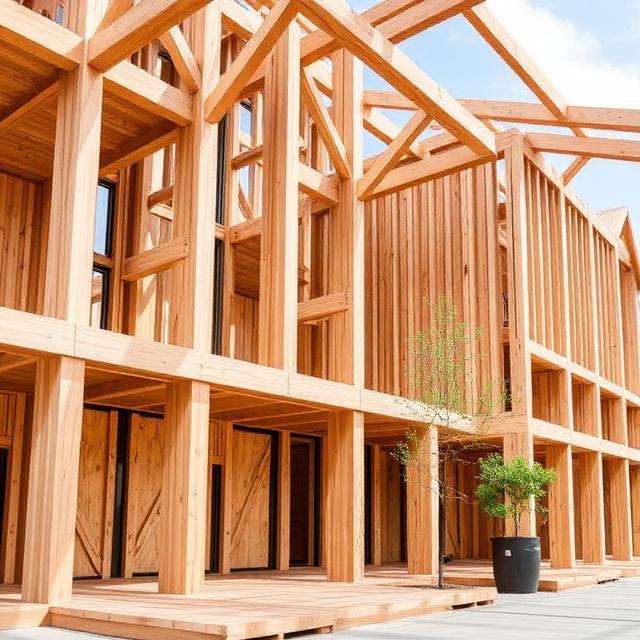
Cross Laminated Timber Glulam
North America is the second-largest region at USD 4,933.10 Million (28.37%) and grows at 7.01%—the fastest of the two large mature markets
EUROPE, UNITED STATES, August 31, 2026 /EINPresswire.com/ -- The Cross Laminated Timber, Glulam, Laminated Veneer Lumber and Laminated Veneer Boards Market is gaining momentum as the construction industry moves toward low-carbon, renewable, prefabricated, and high-performance building materials. Engineered timber products such as cross laminated timber (CLT), glue laminated timber (Glulam), laminated veneer lumber, and laminated veneer boards are increasingly being incorporated into residential, commercial, institutional, and infrastructure projects.According to Market Research Future, the global Cross Laminated Timber, Glulam and LVL/LVB Market was valued at USD 17,386.26 Million in 2025 and is projected to reach USD 32,847.87 Million by 2035, expanding at a 6.72% CAGR during 2026–2035. The market is forecast to reach USD 18,293.04 Million in 2026, indicating continued expansion throughout the forecast period.
Growing Demand for Low-Carbon Construction Materials
The shift toward sustainable construction is one of the strongest factors driving the market. Governments and construction companies are increasingly focused on reducing embodied carbon and improving the environmental performance of buildings.
Engineered timber can support these objectives because wood is a renewable material and can store biogenic carbon. This has increased interest in mass-timber construction as an alternative or complement to conventional concrete and steel systems.
The growing implementation of building-emission requirements and green-building certifications is encouraging architects, engineers, developers, and public authorities to evaluate timber-based structural systems for new projects. MRFR identifies the rising demand for low-carbon construction materials as the largest contributor to market growth.
CLT Adoption Expands in Prefabricated Construction
Cross laminated timber is increasingly being used in prefabricated and modular construction because panels can be manufactured with high precision before being transported to construction sites.
Factory-based manufacturing can reduce on-site labor requirements and shorten construction schedules. This is particularly attractive in regions facing shortages of skilled construction workers.
The growing adoption of CLT in mid-rise buildings is also expanding the addressable market. Developers are increasingly evaluating mass timber for apartment buildings, offices, schools, hotels, and other structures where construction speed and sustainability are important.
Prefabrication and modular construction are projected to grow at a 7.21% CAGR, demonstrating the importance of industrialized construction methods to the overall market.
Download Report Sample Copy: https://www.marketresearchfuture.com/sample_request/68398
Glulam Maintains a Leading Product Position
By product type, the market includes Glulam, Cross Laminated Timber (CLT), Laminated Veneer Lumber (LVL), Laminated Veneer Boards (LVB), and other products.
Glulam remains the largest product category, valued at approximately USD 6.45 billion in 2025, representing 37.11% of the global market. Its established use in long-span roofs, columns, trusses, portal frames, and other structural applications supports its leading position.
Glulam combines individual wood laminations to create structural members with high strength and dimensional stability. Its architectural flexibility also makes it attractive for exposed timber structures.
LVL Gains Momentum in Structural Applications
Laminated veneer lumber is another important engineered timber product. LVL is manufactured by bonding thin wood veneers together, generally with their grain oriented in the same direction.
Its strength and dimensional stability make it suitable for beams, headers, columns, floor systems, and other structural applications.
LVL is projected to expand at a 7.39% CAGR, exceeding the growth rate of Glulam. The increasing use of lightweight framing systems and hybrid timber structures is creating additional opportunities for LVL manufacturers.
Residential Construction Leads Application Demand
Residential construction represents the largest application segment, generating approximately USD 6.02 billion in 2025, equivalent to 34.63% of the total market.
The adoption of engineered timber in residential buildings is supported by growing interest in sustainable housing and prefabricated construction.
Multi-family housing is particularly promising, with the segment growing at a 6.77% CAGR. Modular homes are also expanding at approximately 7.18% CAGR, reflecting the advantages of factory-produced timber components in repetitive residential designs.
Institutional Construction Offers High Growth Potential
Institutional construction is projected to be the fastest-growing top-level application category, registering a 7.70% CAGR.
Hospitals and government buildings are particularly important contributors, growing at approximately 8.63% and 8.20% CAGR, respectively.
Public procurement policies increasingly incorporate sustainability and embodied-carbon considerations. This is creating opportunities for mass-timber solutions in schools, healthcare facilities, public housing, and government buildings.
The use of engineered timber can also contribute to distinctive architectural designs while supporting environmental objectives.
Buy Now: https://www.marketresearchfuture.com/checkout?currency=one_user-USD&report_id=68398
Sustainable Adhesives Influence Product Development
Adhesive technology is an important component of engineered wood manufacturing. The market includes melamine urea formaldehyde, phenol resorcinol formaldehyde, polyurethane, epoxy, and other adhesive types.
Melamine urea formaldehyde represents the leading adhesive category, with approximately USD 5.69 billion in 2025 and a 7.45% CAGR.
Manufacturers are also exploring lower-emission and bio-based adhesive technologies. As environmental requirements become more stringent, adhesive formulations with improved emissions profiles could gain greater attention.
Standard Products Dominate, While Customization Expands
Standard panel and beam sizes currently represent the largest size category, accounting for approximately 66.92% of market value.
However, customized widths are growing faster, with a 7.79% CAGR. Digital manufacturing, CNC processing, and continuous-press technologies are making it easier for producers to manufacture project-specific components.
Customization can improve material utilization and allow architects to develop more complex building designs. It also supports the integration of engineered timber into specialized commercial and institutional projects.
Manufacturing Technology Becomes More Advanced
Conventional pressing remains the largest manufacturing technology, representing approximately 35.34% of the market in 2025. However, continuous press technology is expanding at a faster 7.87% CAGR.
Continuous production can increase manufacturing throughput and improve efficiency for high-volume panel production.
Automation is also becoming increasingly important. Automated cutting, quality inspection, material handling, and digital production planning can help manufacturers improve consistency and reduce production costs.
Building Codes Support Market Expansion
Building-code acceptance is an important factor influencing mass-timber adoption. As more jurisdictions establish standards for timber construction, architects and engineers gain greater confidence in specifying CLT, Glulam, and related products.
Advancements in fire protection, structural engineering, acoustic performance, and connection technologies are also helping engineered timber gain acceptance in larger and taller buildings.
The gradual expansion of code provisions can reduce uncertainty for developers and support broader adoption.
North America Strengthens Its Mass-Timber Industry
North America represents the second-largest regional market, valued at approximately USD 4.93 billion in 2025 and accounting for 28.37% of global value. The region is growing at approximately 7.01% CAGR.
The United States and Canada are investing in mass-timber manufacturing capacity and sustainable construction projects.
Building-code developments, demand for low-carbon buildings, and labor shortages are encouraging developers to consider prefabricated timber construction.
Europe Remains the Largest Regional Market
Europe leads the global market with approximately USD 6.62 billion in 2025, representing 38.10% of global market value.
The region benefits from a mature engineered-timber manufacturing base, established standards, and strong sustainability policies.
Countries across Northern and Central Europe have extensive experience with timber construction, supporting demand for CLT, Glulam, LVL, and related products.
The region's emphasis on reducing building emissions is expected to maintain its leadership through the forecast period.
Asia-Pacific Emerges as the Fastest-Growing Region
Asia-Pacific is projected to be the fastest-growing regional market, registering a 7.58% CAGR. The region accounted for approximately USD 4.22 billion in 2025.
Japan and Australia are important growth markets, supported by timber-construction initiatives and public-building projects. China and South Korea are also developing their prefabricated construction capabilities.
Increasing urbanization and infrastructure investment could provide additional opportunities for engineered timber manufacturers.
Report Summary: https://www.marketresearchfuture.com/reports/cross-laminated-timber-glulam-laminated-veneer-laminated-veneer-boards-market-68398
Competitive Landscape
The market is relatively fragmented, with the top five companies collectively accounting for approximately 25.6% of the market.
Industry participants are focusing on production capacity, product innovation, sustainability, architectural partnerships, and regional expansion.
Companies are also investing in manufacturing technologies that enable customized panels, improved production efficiency, fire protection, and advanced structural applications.
Strategic investments and partnerships are becoming increasingly important as manufacturers seek to establish regional production hubs closer to major construction markets.
Related Report
Glue Laminated Timber Market https://www.marketresearchfuture.com/reports/glue-laminated-timber-market-7225
Cross Laminated Timber Market https://www.marketresearchfuture.com/reports/cross-laminated-timber-market-7962
Nordic Cross Laminated Timber Lumber Processing Market https://www.marketresearchfuture.com/reports/nordic-cross-laminated-timber-lumber-processing-market-63649
high strength laminated adhesive market https://www.marketresearchfuture.com/reports/high-strength-laminated-adhesive-market-36169
adhesion laminated surface protection films market https://www.marketresearchfuture.com/reports/adhesion-laminated-surface-protection-films-market-31699
low temperature laminated glass market https://www.marketresearchfuture.com/reports/low-temperature-laminated-glass-market-39543
glue laminated beam market https://www.marketresearchfuture.com/reports/glue-laminated-beam-market-36121
non laminated heat sealed bags market https://www.marketresearchfuture.com/reports/non-laminated-heat-sealed-bags-market-23794
Market Research Future
Market Research Future
+ +1 855-661-4441
email us here
Legal Disclaimer:
EIN Presswire provides this news content "as is" without warranty of any kind. We do not accept any responsibility or liability for the accuracy, content, images, videos, licenses, completeness, legality, or reliability of the information contained in this article. If you have any complaints or copyright issues related to this article, kindly contact the author above.
