
Emerging contaminants follow distinct rules when partitioning between sediment and water, study finds
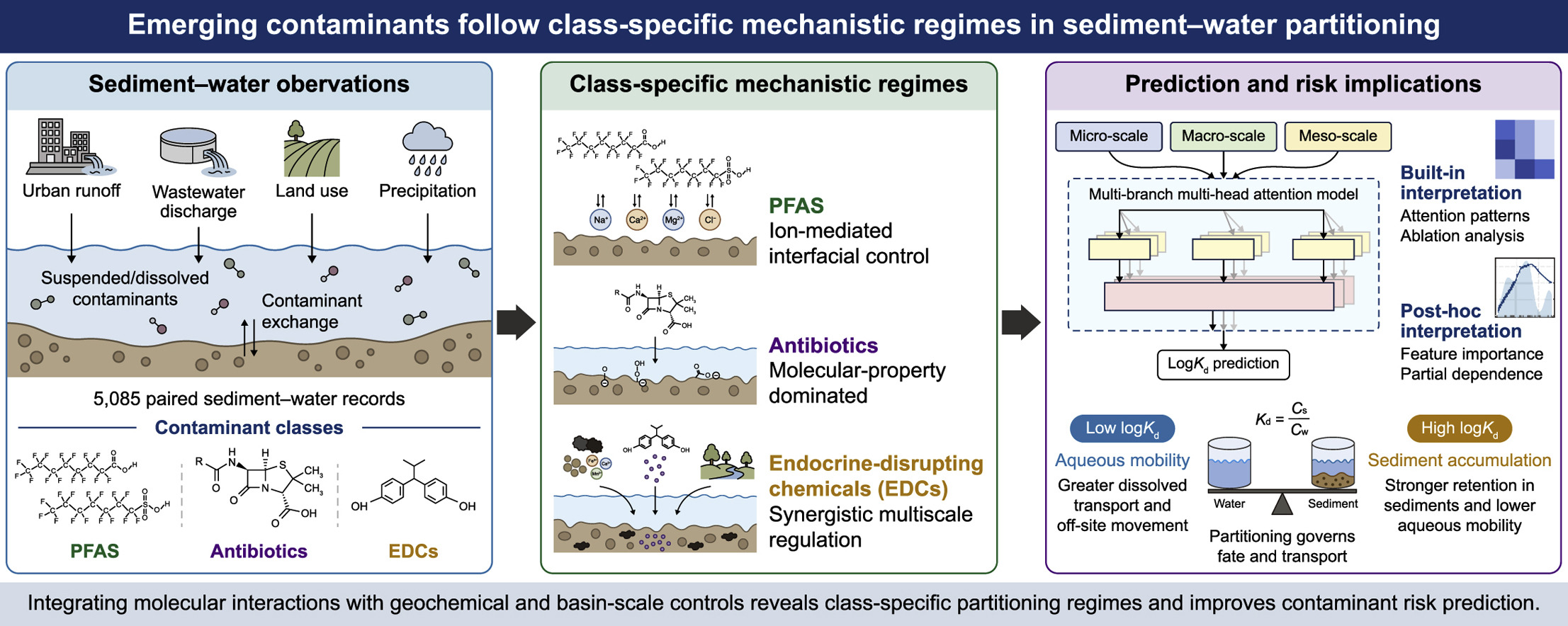
Class-specific mechanistic regimes governing sediment–water partitioning of emerging contaminants.
GA, UNITED STATES, August 31, 2026 /EINPresswire.com/ -- For decades, environmental scientists have struggled to predict where emerging contaminants end up in rivers—whether they linger in sediments or remain mobile in the water. That uncertainty has made risk assessment difficult and management decisions unreliable. Now, researchers have shown that three major classes of emerging contaminants follow fundamentally different mechanistic rules when partitioning between sediment and water, a finding that transforms how these pollutants can be tracked and managed at the basin scale.
Emerging contaminants—including per- and polyfluoroalkyl substances (PFASs), antibiotics (ABs), and endocrine-disrupting chemicals (EDCs)—are increasingly detected in rivers worldwide. Sediments act as both long-term sinks and potential sources in natural aquatic systems, releasing contaminants back into the water under disturbances. Yet direct monitoring of sediment-water partitioning remains challenging due to ultra-trace concentrations, limited sensing technologies, and high analytical costs. Most available data rely on labor-intensive sampling with limited spatial and temporal coverage. Due to these challenges, there is an urgent need for reliable prediction methods that can work across large or data-scarce regions.
Now, a research team from Sun Yat-sen University in Guangzhou, China, has developed a cross-scale predictive framework that reveals exactly how these contaminants behave. Their findings, published on August 14, 2026, in Environmental Science and Ecotechnology, show that antibiotics are primarily governed by molecular descriptors, PFASs are strongly modulated by ion-mediated interfacial processes, and EDCs exhibit synergistic regulation by molecular, geochemical and basin-scale factors.
The team compiled a nationwide dataset of 5,085 paired sediment-water records from 1,093 sampling sites across China's seven major river basins. They then built a multi-branch multi-head attention (MB-MHA) machine learning architecture—a sophisticated framework that processes molecular descriptors, sediment-water properties and basin characteristics through separate but interactive branches. The model achieved exceptional predictive accuracy, with R² values of 0.76 for PFASs, 0.92 for antibiotics, and 0.89 for EDCs—substantially outperforming conventional artificial neural networks. Molecular dynamics simulations further confirmed the class-specific mechanisms at the molecular interface, showing that PFAS compounds form sodium-bridged complexes with mineral surfaces while antibiotics exhibit stronger affinity toward organic matter. The framework also enabled spatially explicit mapping of high-accumulation versus high-mobility zones, providing a quantitative basis for identifying contamination hotspots.
"What surprised us was not that the three classes behaved differently, but just how different the governing mechanisms turned out to be," the authors said. "Antibiotics are largely predictable from molecular structure alone. PFASs are much more sensitive to environmental conditions like temperature and pH. And EDCs sit right in the middle—they're influenced by everything from molecular flexibility to water physiochemistry to how urbanized the basin is. If you try to use one model for all three, you'll get it wrong."
The practical implications are substantial. For antibiotics, molecular descriptors alone can drive reliable predictions—simplifying monitoring efforts. For PFASs, environmental factors such as temperature, pH and sediment organic carbon must be carefully tracked. For EDCs, a multi-scale approach is essential, integrating molecular properties, water quality parameters and basin-scale urbanization patterns. The team demonstrated this framework's utility by generating monthly log Kd projections across the Greater Bay Area—one of the world's most densely urbanized regions—identifying areas where contaminants are likely to accumulate in sediments versus those where they remain mobile in the water column. These maps offer risk-relevant guidance for prioritizing monitoring sites, optimizing discharge schedules and designing adaptive wastewater treatment strategies.
References
DOI
10.1016/j.ese.2026.100751
Original Source URL
https://doi.org/10.1016/j.ese.2026.100751
Funding information
National Natural Science Foundation of China (No. 52200112), General Program of the National Science Foundation of Guangdong Province (2026A1515010474), National Key Research and Development Program of China (2024YFD1701205).
Lucy Wang
BioDesign Research
email us here
Legal Disclaimer:
EIN Presswire provides this news content "as is" without warranty of any kind. We do not accept any responsibility or liability for the accuracy, content, images, videos, licenses, completeness, legality, or reliability of the information contained in this article. If you have any complaints or copyright issues related to this article, kindly contact the author above.
